
Compare
Compare the portfolio. Then compare what governs the agents.
Eleven products are compared below on the work a portfolio office does, and every competitor claim links to the page it was read from. The rest of this page is the axis that comparison does not run: which approved models saw the work, what the agent runs did stage by stage, what they were held to, and which tools they could reach.
- 11products in the table
- 8capabilities compared
- 112sources, each with the date it was read
- 7head-to-heads, each naming where we lose
The position
Two mature categories, and the space between them
A portfolio tool and a coding agent are both finished products, and neither was built to answer the other's question. This is what sits on either side of SprintLoop, and where the documentation on each side stops.
Portfolio tools record what a person entered
A status, a percentage, a health color, a date. That was an accurate model of delivery while a person did the work and could be asked about it a year later.
The AI these products document sits on top of that record. ServiceNow predicts a RAG status per dimension4; Planview’s Copilot summarizes status, flags risk and answers metrics questions43; Clarity ships user-definable agents, bring-your-own model keys and a Model Context Protocol server42. None of the vendor pages read for this comparison documented a register of which models an organization has approved, where an approved model runs, or which model produced a particular change.
Coding agents produce the work
What leaves an agent is a diff, a transcript and a test run. Which portfolio commitment that change served, and which named person accepted it, are facts that live outside the tool that produced it — so a governing record cannot be a byproduct of the tool doing the work.
Forrester describes execution moving to agents while humans stay accountable60, and McKinsey puts the professional’s job at supervising the systems that produce the artifacts rather than producing them57. Neither is a claim about a particular coding tool. Both describe where accountability now has to be written down.
PwC’s guidance on putting agents to work names what a governing record has to carry: verified identity, a defined role, task-specific permissions, auditable activity records and clear limits on autonomous action59. Those are properties of a register, not of a model and not of a delivery board. In a health plan, a bank or a government supplier, that join is what a security review asks for and what usually does not exist.
SprintLoop does not run the agents. It does not execute a build, dispatch a lane, hold a model key, or replace the harness engineers already work in. Agents report into it over a scoped connection that reads the registers and narrates a session, and that connection has no way to accept, sign or disposition anything. What SprintLoop holds is the record: which approved model a run used, what happened at each stage and in each parallel lane, which adopted operating policies the run was held to, and who accepted the result. How the registers fit together.
The second axis
Six capabilities the table has no column for
These are not scored against the products below, and the reason is the same reason the table is worth reading: nobody read those vendors' documentation for agent-run governance, so there is no sourced comparison to make. What there is instead is the file that proves each claim.
Every path below is repository-relative and can be opened in one command. That is the whole standard this page holds itself to.
- The agentic harnessWorkflows are declared with named stages, every run is recorded stage by stage, and parallel lanes declare which files they own.A lane that declares nothing owns nothing. Usage is recorded in tokens, and money appears only where a dated price exists — never as an estimate.supabase/migrations/20260820020000_agentic_harness.sqlsrc/lib/harness/model.ts
- The AI control planeModels are approved one at a time and recorded with where they run, and each approval states in writing whether that model may process regulated content.The register never holds a key — only where one lives, in words. Key-shaped text is refused at write by the database, not by a form.supabase/migrations/20260820100000_provider_credentials.sqlsupabase/migrations/20260820200000_ai_credential_repair.sqlsrc/lib/harness/model.ts
- Tool permissionsThe catalog of tools an agent can call is derived from the server that publishes them, and anything that writes is denied until a named person grants it.A refusal names the tool, never the payload. An agent cannot grant itself a tool: every grant is a named person's act.supabase/migrations/20260820190000_tool_permission.sqlsrc/app/api/mcp/route.tssrc/lib/tool-permission/gate.ts
- Operating policiesNine policies ship with the product, each adopted by a named person at a stated enforcement level, and the verdict for a run is sealed against the bytes it was about.A policy with no verdict on a run reads as not evaluated — never as passed. Verdicts are append-only, and a waiver that names nobody is refused by the database.supabase/migrations/20260820020000_agentic_harness.sql
- The gated AI SDLCA pinned methodology of seven phases and thirteen blocking control gates in four bands, ending in a risk acceptance signed by a named release authority.There is no gate percentage and no gate health score anywhere in the product. A gate is signed by a named person holding the owning role, waived with a recorded reason, or it is open.supabase/migrations/20260814000000_methodology_gates.sqlsrc/lib/gates.ts
- Evidence that leaves the buildingDeck and trail exports carry an Ed25519 receipt over canonical bytes, and the public key travels inside the receipt.A claim whose count exceeds its own denominator is not rounded: the receipt is not issued. There is no partial receipt.src/lib/evidence/receipt.tssrc/lib/evidence/canonical.tssrc/app/verify/page.tsx
The AI control plane
Where a model runs decides what it may be shown
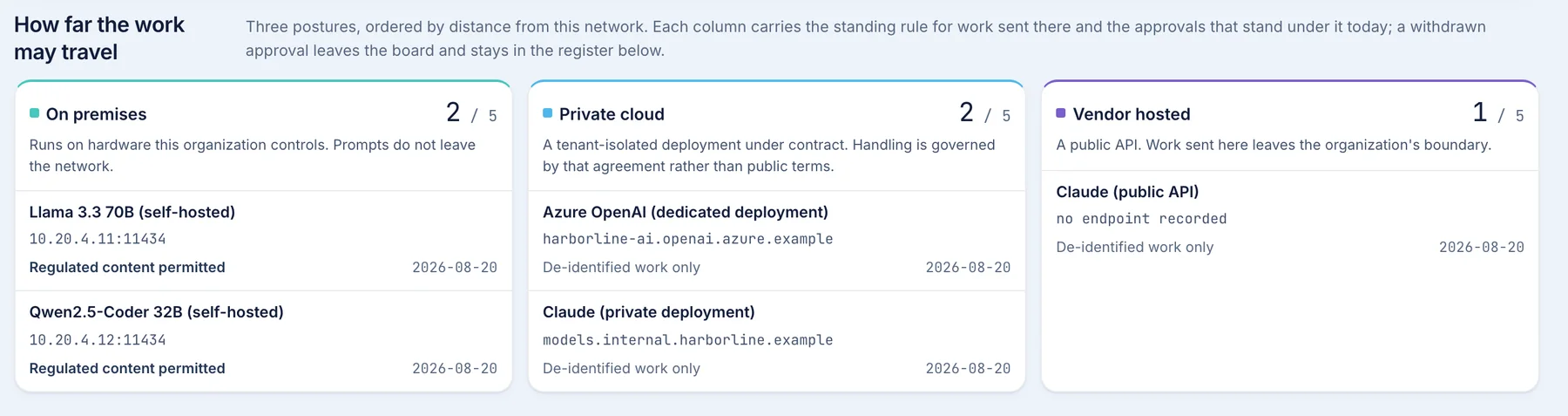
Models are approved one at a time and recorded with where they run, and each approval states in writing whether that model may process regulated content.
The register never holds a key — only where one lives, in words. Key-shaped text is refused at write by the database, not by a form.
- On premisesRuns on hardware this organization controls. Prompts do not leave the network.
- Private cloudA tenant-isolated deployment under contract. Handling is governed by that agreement rather than public terms.
- Vendor hostedA public API. Work sent here leaves the organization's boundary.
A workspace holds several approvals at once, each with its own boundary and its own ceiling, and a retired one stays listed with the date and the person — because the runs that happened under it did happen.
The gated AI SDLC
Thirteen blocking control gates, in four bands
There is no gate percentage and no gate health score anywhere in the product. A gate is signed by a named person holding the owning role, waived with a recorded reason, or it is open.
- 4 / 13Intake and design assuranceInitiation · Architecture review · Threat modeling · Secure design validation
- 4 / 13Build and runtime securityCode and build security · Infrastructure security · Dynamic testing · Penetration testing
- 4 / 13Access, data and operationsIdentity and access review · Data protection review · Logging and monitoring · Incident response readiness
- 1 / 13Final risk acceptanceFinal risk assessment, signed by the release authority
One further check runs continuously after deploy and reports without withholding a release, which is why it is not one of the thirteen.
The capability table
Eight capabilities a PMO actually evaluates
Rows are what a portfolio office is buying. Columns are the ten established products in this review, plus SprintLoop. Cells describe the documented operating model, so you can match each product to the work your portfolio office performs.
Superscripts link to the vendor documentation each claim was read from, and the register at the foot of this page carries the date each page was read.
“Not verified against a vendor page in this pass.” means the research pass found the capability described but could not point to a page from the vendor stating it. The cell says so rather than borrowing a claim from somewhere else — a comparison table with no gaps in it is a comparison table nobody checked.
| Capability | SprintLoop | Planview Portfolios | Broadcom Clarity | Sciforma | ServiceNow SPM | Jira Align | Asana | monday.com | Smartsheet | Wrike | Celoxis |
|---|---|---|---|---|---|---|---|---|---|---|---|
| Project health computationWho decides the color, and can you decompose it afterward? | There is no health score and no RAG state. Counts are printed beside their denominators — 14 of 40 verified — and never averaged. | Manual RAG set by the project manager in status updates, with a fourth gray state meaning not reported.1 | The manager picks three dimension statuses; the overall gauge sums them at 10, 20 or 30 — green under 40, yellow to 89, red at 90.2 | Manual RAG on status reports plus an auto-computed Global Score out of 100: weighted Time, Cost and Quality over the sum of the weights.3 | Manual, or derived from the latest status report, or predicted per dimension by AI Status Reports behind a Now Assist license.4 | Manual RAG across five dimensions with a typed reason, and no history retained — a point-in-time view.5 | A person picks on track, at risk or off track; the AI drafts the prose around the choice.6 | Status is hand-set. A separate daily AI scan of boards and activity flags risks with a severity beside it.730 | A red, yellow or green ball in a symbols column — set by hand, or by an IF formula the customer writes.8 | A machine-learning risk model sets it; the manual health color was replaced by the prediction.9 | Computed daily from projected finish and projected cost — and overridable per project by a setting that assumes the project is on time and on budget.10 |
| Resource capacity and allocationWho is overloaded next month, and did they agree to the work? | A member states capacity as hours with an effective date; load is the sum of allocations a named person accepted, printed as hours beside hours. No requisitions, no skills inventory, no leveling, no utilization heat map. | Time-phased capacity targets at any level of the organization, demand-versus-capacity balancing, skills profiles and timesheets.11 | The deepest in this survey: soft and hard booking as separate access rights, a formal requisition workflow, role capacity histograms, skills inventory and native timesheets.1213 | A request-and-fulfill workflow between manager and resource manager, hard and soft allocation, capacity charts, leveling and three-role timesheet approval.14 | Resource plans with soft and hard allocations and a resource workspace — with limits the vendor's own guide names: no batch approval, and availability consumed before approval.15 | Team-level only, in story points or member-weeks. No named-person allocation and no booking model.16 | Capacity planning allocates people to projects by percent or hours, without assigning them tasks.17 | Workload visualization on the board rather than an availability model.30 | Real FTE and hours math — in the separately sold Resource Management product, which the newer Portfolios feature does not support.1819 | Job roles, daily-capacity work schedules, effort-bearing workload charts, and Bookings: role-level reservations made before tasks exist, at the top tiers.20 | Not verified against a vendor page in this pass. |
| Financials: plan, actuals, forecastWhat did we say it would cost, what has it cost, and who says so? | Planned amounts and recorded actuals side by side, each actual carrying the document it was copied from, and the signed subtraction between them. No forecast column, no projected cost, no percent complete anywhere on the page. | Financial planning, forecast and actuals, agile costing, and an explicit capital-versus-operating split with auditable actual costs.2122 | Cost plans to approved budget plans to benefit plans, net present value, capital and operating cost separation, and chargebacks across departments.2324 | Portfolio simulation in a sandbox: which projects can launch and when, under cash, cost and effort budget constraints.25 | Two funding data models — Investment Funding, or the planning workspace's scenario financials — and a customer picks one, because the two are incompatible.2627 | Forecasted, estimated and accepted spend against a portfolio funding plan; blended rates or per-person cost centers; capital flags at portfolio and program level.28 | No budgeting, cost tracking or return-on-investment tracking at all.29 | Money is a number column somebody adds to a board.30 | No budget engine in the portfolio feature — sheets the customer builds.19 | A real engine: planned and actual fees and costs computed from rates, effort and approved time logs.31 | Estimated, actual and projected cost against budget, with rates and per-project overrides — and no capital-versus-operating split, no chargebacks, no time-phased budget plans.32 |
| Benefits realizationDid the thing we funded produce what we said it would? | A benefit is a claim a named person made, with a target and a basis. Its position is the newest measurement recorded against it, with a source and a date. Nothing is a percentage realized, and nothing is summed across units. | An Outcomes pillar with an outcome lifecycle from launch to sunset; quantified benefit-versus-actual mechanics are not documented publicly.21 | Time-phased benefit plans carrying planned, actual and variance for each period.33 | A module rather than a field: benefits cataloged, attached to projects, with time-distributed targets and current-versus-target-versus-expected tracking.34 | Benefit plans with actuals at breakdown level.35 | Not verified against a vendor page in this pass. | Goals give alignment; there is no benefit ledger behind them.29 | No benefits register in the documented portfolio feature set.30 | No benefits register in the documented portfolio feature set.19 | No benefits register in the documented budget and portfolio feature set.31 | Not verified against a vendor page in this pass. |
| Cross-initiative dependenciesDid the team on the other end agree to this, or is it a line on a diagram? | A dependency is a contract: requested by one initiative, accepted by a person answering for the other, both signatures stamped by the database from the session. A request nobody has answered is shown, counted, and held outside every dependency figure. | A platform pillar; the AI dependency layer, the Connected Work Graph, was announced in February 2026 and is not evidenced as generally available.37 | Not verified against a vendor page in this pass. | Not verified against a vendor page in this pass. | Not verified against a vendor page in this pass. | The signature strength of the product: a dependency is a contract between two teams — the requesting team proposes, the responding team accepts or counter-proposes.36 | Task dependencies with a thirty-per-task cap and no propagation across projects.29 | A portfolio feature exists; its dependency content was not verified against a vendor page in this pass.30 | No cross-sheet dependency model in the portfolio feature; the practitioner answer is a cell-link workaround.19 | Not verified against a vendor page in this pass. | Full finish-to-start and its three siblings with lead and lag; an inter-project link needs the predecessor's system identifier typed into an edit form.38 |
| Traceability to code evidenceCan the tool answer “which commit, and did the test run?” | A requirement's citations resolve against one pinned commit; a test result binds the requirement at the rung the evidence supports; a skipped test binds nothing and a failing test still binds, with the failure as its outcome. Exports carry a signed receipt anyone can check without an account. | Hub synchronizes 60-plus tools bi-directionally, including GitHub and GitLab. Sync state, not a binding to a commit.39 | The 16.4.2 line ships a server for the Model Context Protocol — driving timesheets from an external assistant.42 | Not verified against a vendor page in this pass. | Not verified against a vendor page in this pass. | Not verified against a vendor page in this pass. | Native two-way synchronization with Jira; the portfolio object is a project, not a requirement bound to evidence.29 | Not verified against a vendor page in this pass. | Not verified against a vendor page in this pass. | Wrike Sync connects development tools including GitLab; the connection carries work items rather than evidence.41 | Jira and Azure DevOps synchronization is a one-way pull, triggered by hand.40 |
| AI pricing modelDoes the intelligence stop working when the credits run out? | Each organization supplies its provider key. Calls are ledgered against a monthly ceiling before they run, and AI-generated plans or updates remain proposals until a named person accepts them. | Copilot reached general availability in the November 2024 release with status summarization, risk flagging and metrics questions; its pricing is not published.43 | Vaia, user-definable agents, bring-your-own model keys for Anthropic, OpenAI and Google, and a Model Context Protocol server — shipped in the 16.4.x line.42 | No native AI in the releases searched before the acquisition; the health score is a formula rather than a model.3 | Generally available and license-gated behind Now Assist and the higher SPM tier.444 | No native generally available generative AI; the concrete artifact is a read-and-summarize Rovo skill in an early access program.45 | AI Studio is a credit-metered add-on gated to the higher annual plans.46 | AI is sold as credits, at roughly a cent each, with minimums by tier.47 | Smart Assist, AI formulas and AI dashboard generation.48 | A machine-learning risk model. No agent platform documented.9 | An assistant called Lex is presented as generally available on the marketing page; no dated release notes were found for it.49 |
| Portfolio tier gatingWhat does the portfolio layer cost on top of the seats? | Caps are seats and initiatives, stated before they refuse. The governance layer — the trail, custody, agent sessions, evidence receipts — is not a tier. | An enterprise product; integration to other tools is the separately purchased Hub.39 | An enterprise license; what-if portfolio plans with ranked waterlines are core rather than an add-on.50 | Sold within the Planview line since the February 2025 acquisition, rebranded ProjectAdvantage.52 | Portfolio Planning sits in Advanced and Strategic Planning in Prime — two workspaces split by license.27 | The Strategy Collection is listed at $77,400 a year for 1 to 50 full users; integrated Jira users are free.53 | Portfolio management sits in Advanced and above.29 | Portfolio is Enterprise-only, and capped at 200 projects and 20,000 items.30 | Portfolio depth is the Control Center add-on, or Enterprise.19 | The real machinery needs Pinnacle or Apex plus the Sync, Analyze and Datahub add-ons.2054 | Not verified against a vendor page in this pass. |
Evidence binding is where the row splits. The vendor pages reviewed here document synchronization with development tools; they did not document binding a requirement to both a specific commit and a test execution. Synchronization moves work items, while an evidence binding records what supports a requirement at a particular point in time.
At length
Seven head-to-heads, each naming where we lose first
These focused comparisons add operating context to the capability table. Every one of them states where SprintLoop is the weaker choice before it says where it is the stronger, and ends by describing the buyer who should choose the other product.
- SprintLoop vs Planview PortfoliosCompare enterprise portfolio depth with evidence-led delivery governance.
- SprintLoop vs Broadcom ClarityCompare the deepest financial and resource model in enterprise PPM with an evidence-led register.
- SprintLoop vs ServiceNow SPMCompare platform-scale planning with traceable evidence and human-approved AI proposals.
- SprintLoop vs Jira + Jira Product DiscoveryKeep Jira; govern the layer above the board — requirements, custody and evidence, joined to the portfolio decision each one serves.
- SprintLoop vs Jira AlignCompare team-level alignment with signed cross-initiative decisions and evidence.
- SprintLoop vs SmartsheetCompare a portfolio you assemble from sheets with one the product defines and can verify.
- SprintLoop vs monday.comCompare work management people enjoy using with a portfolio record that does not expire.
Choosing
Two lists, set at the same weight
The left column is the honest reason to buy something else, with the vendor page each claim was read from. It is set in the same type, at the same size, in the same rhythm as the right — a comparison whose losing column is smaller than its winning one is an advertisement.
Where the specialists go deeper
- Enterprise resource managementSprintLoop records stated capacity and person-accepted allocations in hours. Clarity adds soft and hard booking, requisition workflows, role capacity and skills inventory1213; Sciforma adds allocation workflows and leveling14. A PMO brokering people across a large shared-services pool will find more depth in those specialist resource models.
- Portfolio optimizationSprintLoop lets a named person record a scenario, its project stances, funding references and notes, then compare funding, capacity, benefits and dependencies with each basis and denominator visible. It does not rank alternatives or select a preferred portfolio. Planview publishes optimized scenarios into a plan of record51; Clarity ranks investments against waterlines50; Sciforma simulates launch dates under budget constraints25.
- Time capture and labor accountingClarity, Sciforma and Wrike provide time capture, and Wrike’s budget engine computes cost from rates, effort and approved time logs31. SprintLoop does not replace a timesheet or a labor capitalization system.
- Advanced schedulingSprintLoop presents recorded dates and gate milestones. It does not calculate critical path, auto-schedule downstream work or level resources across a Gantt plan; keep a scheduling tool where those functions are central to delivery planning.
- Financial forecastingSprintLoop shows planned amounts, sourced actuals and the difference between them. It does not extrapolate a landing cost from percent complete. Celoxis includes projected cost and daily status calculations1032.
- Breadth of connectorsSprintLoop accepts structured registers and test results, resolves repository evidence at a pinned commit, and exposes scoped synchronization credentials. Planview Hub documents connections to more than 60 tools39. There is no comparable catalog of enterprise resource planning and service management connectors here.
- Independent assuranceSprintLoop does not currently hold SOC 2 Type II, HITRUST or FedRAMP attestations, or a penetration-test summary dated within twelve months. Where an attestation is a gate today, that is a reason to choose an incumbent. Review the security posture.
- Enterprise identityEnterprise SAML sign-in is implemented and becomes available once the deployment and the identity provider are configured. SCIM provisioning is not currently included, and a directory-driven joiner-mover-leaver process is better served by a platform that ships it.
Where this one is the answer
- The delivery work is machine-producedA run names the approved model it ran under, and the approval names where that model runs and whether it may be shown regulated content. “Which of our projects had agent work on a model that can send text outside this organization” is a query rather than an investigation.
- A security review asks what the agents could reachThe tool catalog is derived from the server that publishes it, anything that writes is denied until a named person grants it, and the refusal is recorded with whether the call was stopped or only watched.
- A requirement has to resolve to somethingRequirements resolve against a pinned commit and bind to a test execution at the level the evidence supports. Synchronization moves work items; a binding records what supports a requirement at a particular point in time.
- A report has to survive leaving the buildingDeck and trail exports carry an Ed25519 receipt over canonical bytes, with the public key inside it. A reviewer checks one at the public verifier with no account and no call back to this application.
- Nobody will accept a health colorThere is no RAG state and no health score anywhere in the product. Counts print beside their denominators and are never averaged, and a claim whose count exceeds its own denominator does not get a receipt at all.
Questions a buyer asks
Scope, operating model, assurance
The questions that shape an evaluation, answered once, in the same words the structured data on this page carries.
- What is project portfolio management (PPM) software?
- Project portfolio management software is the layer above delivery tools. Where Jira or Azure DevOps track individual work, PPM tools hold the portfolio: which projects and programs are funded, what they were meant to achieve, who owns them, what they cost, which risks and dependencies connect them, and how each one is progressing. A PMO uses it to decide what to start, continue, or stop, and to answer questions about the portfolio afterward.
- Which PPM tools does SprintLoop compare against?
- The capability table on this page covers eleven products: SprintLoop, Planview Portfolios, Broadcom Clarity, Sciforma, ServiceNow SPM, Jira Align, Asana, monday.com, Smartsheet, Wrike, Celoxis. Seven have a full head-to-head page. Every competitor claim links to that vendor's own documentation with the date it was read, and each comparison states where SprintLoop is the weaker choice.
- What makes SprintLoop AI-native PPM rather than PPM with AI added?
- AI-native here means the decision boundary is built into the product rather than configured on top of it. An AI proposal is an unchangeable record that a named person must accept or reject before the portfolio changes, and who accepted is taken from that person's signed-in session — an agent has no identity to be recorded as. Most PPM tools added AI that summarizes status or predicts a health color; SprintLoop assumes the delivery work itself is increasingly machine-produced, and records what was produced, against which pinned commit, and who accepted it.
- Does SprintLoop run the AI agents?
- No. SprintLoop does not execute a build, dispatch a lane, or hold a model key, and it does not replace the harness engineers already work in. Agents reach a workspace over a scoped connection that reads the registers and narrates its own session, and that connection has no way to accept, sign or disposition anything. What SprintLoop holds is the record: which approved model a run used, what happened at each stage and in each parallel lane, which adopted operating policies the run was held to, and which named person accepted the result.
- How does SprintLoop know which model touched a piece of work?
- Each workspace keeps a model register: the models it has approved, where each one runs — on hardware the organization controls, in a tenant-isolated deployment under contract, or behind a public API — and whether work carrying regulated or member-identifying content may reach it, which is a separate decision that starts at no. A run records which approved model it used. That makes “which of our projects had agent work on a model that can send text outside this organization” a query rather than an investigation.
- Which tools can an agent call, and what happens when it calls one it was not granted?
- The catalog of callable tools is derived from the server that publishes them rather than typed into a settings page, and anything that writes is denied until a named person grants it. The check runs at the workspace endpoint before the tool executes. A refusal is written by the database rather than by the application, and it records which tool was asked for, why the answer was no, and whether the call was actually stopped or only watched — because a control a workspace deliberately made advisory is not a control it is protected by.
- Does SprintLoop have a RAG status or a project health score?
- SprintLoop reports the underlying facts instead of combining them into one health score: verified requirements beside total requirements, signed gates beside total gates, and unresolved findings by class. Teams can review each input without reverse-engineering an average or color.
- How is SprintLoop different from Planview or Broadcom Clarity?
- Planview and Clarity go deeper in resource booking, requisitions, chargebacks and portfolio optimization. SprintLoop focuses on evidence-led governance: requirements resolve against a pinned commit, test results bind at the level the evidence supports, recorded scenarios retain their assumptions, and signed exports can be checked without an account.
- Does SprintLoop replace Jira or Azure DevOps?
- SprintLoop complements delivery trackers. Jira and Azure DevOps manage day-to-day work; SprintLoop connects portfolio decisions, requirements, evidence, approvals and reporting across that work.
- How does AI usage work in SprintLoop?
- Each organization supplies its own supported provider key. Calls are recorded in a usage ledger and checked against the organization's monthly ceiling before they run. AI can draft a project plan or status update, but the result enters the proposal register and a named person decides whether to accept it.
- Is SprintLoop SOC 2 certified?
- SprintLoop does not currently hold SOC 2, HITRUST or FedRAMP attestations. The security page separates those independent assurance artifacts from implemented controls and publishes dated evidence for tenant isolation and cross-tenant refusal testing.
- Can an AI agent approve or sign anything in SprintLoop?
- AI actions create proposals, not approvals. Accepting or rejecting one requires a signed-in person, and who accepted is taken from that session rather than from anything the proposal supplies.
- What does SprintLoop not do that Clarity or Planview does?
- SprintLoop does not provide resource requisitions, soft or hard booking, skills inventories, resource leveling, timesheets, labor capitalization, critical-path scheduling, percent-complete cost forecasting or departmental chargebacks. Its scenario workspace compares recorded assumptions and constraints; it is not an optimization engine. Enterprise SAML sign-in is implemented and requires identity-provider activation for each deployment.
- Can somebody outside the company check a SprintLoop report?
- Yes. Deck and trail exports carry an Ed25519-signed receipt covering the counts, acceptances and pinned commit. Anyone can check a receipt at sprintloop.ai/verify without an account or a call back to the application.
The register
112 sources, each carrying the date it was read
Each line carries the kind of source and the date it was read, so vendor documentation, marketing material and independent assessments stay distinguishable — and so a claim that has aged is visible as an aged claim rather than an undated one. These were read on 2026-08-14 and 2026-08-17.
- 1Planview — Update project status to portfolios (four RAG states, including gray for “not reported”)vendor documentation · read 2026-08-14
- 2Broadcom Clarity — Project Status Summary report (dimension statuses summed 10/20/30; green under 40, yellow 40–89, red 90 and above)vendor documentation · read 2026-08-14
- 3Sciforma — Project Health Score (weighted Time, Cost and Quality scores, out of 100)vendor documentation · read 2026-08-14
- 4ServiceNow — AI Status Reports (RAG predicted per dimension, behind Now Assist)vendor community article · read 2026-08-14
- 5Atlassian — A Project Manager Guide to Jira Align, Part 3 (five-dimension manual health, no history retained)vendor community article · read 2026-08-14
- 6Asana — Portfolio progress and reportingvendor documentation · read 2026-08-14
- 7monday.com — Portfolio management: Risk insightsvendor documentation · read 2026-08-14
- 8Smartsheet — Available symbols in a symbols columnvendor documentation · read 2026-08-14
- 9Wrike — AI Project Risk Predictionvendor documentation · read 2026-08-14
- 10Celoxis — RAG indicators (computed daily; per-project “always assume this project is on time and budget” setting)vendor documentation · read 2026-08-14
- 11Planview — Capacity Planning capabilityvendor documentation · read 2026-08-14
- 12Broadcom Clarity — Resource management (16.4.1)vendor documentation · read 2026-08-14
- 13Broadcom Clarity — Manage requisitionsvendor documentation · read 2026-08-14
- 14Sciforma — Allocation request workflowvendor documentation · read 2026-08-14
- 15ServiceNow — Resource assignment and capacity planning guidevendor community article · read 2026-08-14
- 16Atlassian — Calculate team load widget details, Program Roomvendor documentation · read 2026-08-14
- 17Asana — Capacity planningvendor documentation · read 2026-08-14
- 18Smartsheet — Resource Management capacity view (FTE and hours)vendor documentation · read 2026-08-14
- 19Smartsheet — Portfolios overviewvendor documentation · read 2026-08-14
- 20Wrike — Bookings (role-level reservations, top tiers)vendor documentation · read 2026-08-14
- 21Planview — Planview Portfolios data sheet (PDF)vendor documentation · read 2026-08-14
- 22Planview — CapEx versus OpExvendor documentation · read 2026-08-14
- 23Broadcom Clarity — Display capital and operating costsvendor documentation · read 2026-08-14
- 24Broadcom Clarity — Financial management (16.1.3)vendor documentation · read 2026-08-14
- 25Sciforma — Portfolio simulationvendor documentation · read 2026-08-14
- 26ServiceNow — Quick start guide for financial planningvendor community article · read 2026-08-14
- 27ServiceNow — Quick start guide for strategic and portfolio planning (Portfolio Planning in Advanced, Strategic Planning in Prime)vendor community article · read 2026-08-14
- 28Atlassian — Financials in Jira Alignvendor community article · read 2026-08-14
- 29Acuity PPM — Asana for portfolio management (independent assessment: no budgeting, cost tracking or ROI)third-party assessment · read 2026-08-14
- 30monday.com — The portfolio solution (Enterprise; 200 projects, 20,000 items)vendor documentation · read 2026-08-14
- 31Wrike — Budgeting in Wrike (rates, effort and time logs)vendor documentation · read 2026-08-14
- 32Celoxis — Budgeting and costingvendor documentation · read 2026-08-14
- 33Broadcom Clarity — Working with benefit plans (planned, actual and variance per period)vendor documentation · read 2026-08-14
- 34Sciforma — Attach a benefit to a project and define target valuesvendor documentation · read 2026-08-14
- 35ServiceNow — Benefits realization management (community thread)vendor community article · read 2026-08-14
- 36Atlassian — Flow of dependency management in Jira Align (a dependency is a contract between two teams)vendor community article · read 2026-08-14
- 37Planview — Connected Work Graph, AI dependency intelligence (announced 2026-02-10)vendor newsroom · read 2026-08-14
- 38Celoxis — Task dependency in another projectvendor documentation · read 2026-08-14
- 39Planview — Hub (60-plus tools, bi-directional sync)vendor documentation · read 2026-08-14
- 40Celoxis — Jira and Azure DevOps integration (one-way pull, manually triggered)vendor documentation · read 2026-08-14
- 41Wrike — Wrike Sync (including GitLab)vendor documentation · read 2026-08-14
- 42Broadcom Clarity — Using Clarity Vaia (agents, bring-your-own LLM keys, MCP server)vendor documentation · read 2026-08-14
- 43Planview — Copilot general availability (release of 2024-11-20)vendor newsroom · read 2026-08-14
- 44ServiceNow — Now Assist for SPM release notes (Yokohama)vendor documentation · read 2026-08-14
- 45Atlassian — Jira Align Rovo skill, Early Access Programvendor community article · read 2026-08-14
- 46Asana — AI Studiovendor documentation · read 2026-08-14
- 47monday.com — AI feature catalog, with credit pricingvendor documentation · read 2026-08-14
- 48Smartsheet — AI toolsvendor documentation · read 2026-08-14
- 49Celoxis — AI project management (“Lex”)vendor marketing · read 2026-08-14
- 50Broadcom Clarity — Explore alternate portfolio plans (waterlines)vendor documentation · read 2026-08-14
- 51Planview — Investment and Capacity Planning: Rank, Analyze, Shift and Balance viewsvendor documentation · read 2026-08-14
- 52Planview — acquisition of Sciforma (2025-02-18)vendor newsroom · read 2026-08-14
- 53Tability — Jira Align pricing (Strategy Collection, 1–50 full users, $77,400 a year)third-party assessment · read 2026-08-14
- 54Hackceleration — Wrike review (tier and add-on sprawl)third-party assessment · read 2026-08-14
- 55Wellingtone — The State of Project Management 2026, press release (72% collate reports for half a day or more each month; 44% dissatisfied with PMO reporting)practitioner research · read 2026-08-14
- 56Gartner press release, 2026-07-07 — 60% of organizations will run smaller software engineering teams at scale by 2029, up from 15% in 2026analyst press release · read 2026-08-14
- 57McKinsey — Rewiring software delivery for the agentic era (the professional's job moves from producing artifacts to supervising the systems that produce them)consultancy research · read 2026-08-14
- 58BCG Platinion — The Agentic Software Factory, 2026-03-26 (as few as three engineers run delivery; every stage gate has a human accountable for approval)consultancy research · read 2026-08-14
- 59PwC — AI agent governance for workforce use (verified identity, defined role, task-specific permissions, auditable activity records, clear limits on autonomous action)consultancy research · read 2026-08-14
- 60Forrester — Agentic software development takes the lead: humans stay accountable, but AI does more of the executionanalyst blog · read 2026-08-14
- 61METR — randomized trial: experienced developers were 19% slower with AI tools while believing they were 20% fasterprimary study · read 2026-08-14
- 62Atlassian — What is Jira Product Discovery (capture and prioritize ideas; connect product ideas to the dev work in Jira)vendor documentation · read 2026-08-19
- 63Atlassian — Create a matrix view in Jira Product Discovery (plots ideas based on two fields, e.g. value against effort; ideas without a value for both axes do not appear)vendor documentation · read 2026-08-19
- 64Atlassian — Audit activities in Jira applications (“The audit log is not intended to record all activity in Jira”; configuration changes and work-item deletions; retention configurable)vendor documentation · read 2026-08-19
- 65Atlassian — What is Rovo (agents perform specialized skills, with your permission, like organize, create, or edit Jira work items or Confluence pages)vendor documentation · read 2026-08-19
- 66Atlassian — Jira Product Discovery pricing (Free with 3 creators; Standard $10 and Premium $25 per creator/month; contributors free)vendor marketing · read 2026-08-19
- 67Broadcom Clarity — Portfolio management (a portfolio is a snapshot of investment data, refreshed on a cadence you set)vendor documentation · read 2026-08-17
- 68Broadcom Clarity — Top-down planning with roadmaps (one scenario per roadmap is tagged the plan of record)vendor documentation · read 2026-08-17
- 69Broadcom Clarity — Beta features in Clarity 16.4.3 (Global Search, Chart Range, Import from CSV, Plans, Queries; no guarantee a beta feature reaches general availability)vendor documentation · read 2026-08-17
- 70Broadcom Clarity — SaaS service description (no database schema customization; subscribers run the current version; backups retained seven days)vendor documentation · read 2026-08-17
- 71Broadcom Clarity — Clarity is FedRAMP authorizedvendor documentation · read 2026-08-17
- 72Broadcom Clarity — View user counts by license type (access rights determine the license; the highest license type prevails)vendor documentation · read 2026-08-17
- 73Broadcom Clarity — Add-ins and integrations (Rally, Microsoft Project, Open Workbench in product; Jira, Azure DevOps and ServiceNow through ValueOps ConnectALL)vendor documentation · read 2026-08-17
- 74Broadcom — announcement of a Leader placement in the 2025 Gartner Magic Quadrant for Strategic Portfolio Management, second consecutive yearvendor newsroom · read 2026-08-17
- 75Smartsheet — Essentials glossary (a sheet is “the foundation of your work in Smartsheet”)vendor documentation · read 2026-08-17
- 76Smartsheet — Set up a blueprint summary sheet (project values are cell-linked into the summary sheet; matching columns are configured by hand)vendor documentation · read 2026-08-17
- 77Smartsheet — Define and track a project with profile data (enter RYG project health outside the summary and reference it with a formula)vendor documentation · read 2026-08-17
- 78Smartsheet — Control Center limitations (60,000 projects per program; 500,000 inbound cell links per summary; 40 auto-provisioned projects per hour at P95)vendor documentation · read 2026-08-17
- 79Smartsheet — Request approval from stakeholders (an approval request is not initiated when the trigger cell is linked to other cells or carries a cross-sheet formula)vendor documentation · read 2026-08-17
- 80Smartsheet — Manage my subscription (Resource Management licenses are sold separately from Smartsheet seats; only licensed users can track time)vendor documentation · read 2026-08-17
- 81Smartsheet — Track sheet changes with the activity log (each download is limited to 90 days of activity data)vendor documentation · read 2026-08-17
- 82Smartsheet — System requirements (20,000 rows, 400 columns and 500,000 cells per sheet)vendor documentation · read 2026-08-17
- 83Smartsheet — API limitations (connectors including Jira, Tableau, Power BI and Bridge are unsupported above 5,000 rows or 200 columns)vendor documentation · read 2026-08-17
- 84Smartsheet — AI management overview (formula creation, data analysis and text summaries are Enterprise-only; each capability has an admin toggle)vendor documentation · read 2026-08-17
- 85Smartsheet — Pricing (Pro and Business list per member per month; Control Center and Resource Management are add-ons with no published price)vendor marketing · read 2026-08-17
- 86monday.com — The dashboards (connected boards capped by plan at 1, 5, 20 and 50; portfolio rollup data is not available as board columns and cannot be surfaced in a widget)vendor documentation · read 2026-08-17
- 87monday.com — Portfolio at scale (in beta and rolling out gradually; automations on rollups, Portfolio Snapshot, Portfolio Workload, risk insights, API access and mobile access are listed as not yet supported)vendor documentation · read 2026-08-17
- 88monday.com — The activity log (retained one week on Basic, six months on Standard, one year on Pro and five years on Enterprise; item updates are not tracked)vendor documentation · read 2026-08-17
- 89monday.com — The audit log (Enterprise and admins only; logins, devices, exports and downloads; records are currently not deleted after a set time)vendor documentation · read 2026-08-17
- 90monday.com — The status column (labels are set by hand, up to 40; a used label can be deactivated but not deleted; “done” is a color each board chooses)vendor documentation · read 2026-08-17
- 91monday.com — The workload widget (Pro and Enterprise only; a work schedule is assigned to a team and applies to every user in it)vendor documentation · read 2026-08-17
- 92monday.com — Resource management for Enterprise (project-board tasks do not appear in the resource planner and assignees are not notified; utilization data refreshes every 24 hours)vendor documentation · read 2026-08-17
- 93monday.com — Linkage limitations for the connect boards column (connected boards capped by plan; 750 connected items per cell)vendor documentation · read 2026-08-17
- 94monday.com — Available plan types (monthly automation and integration action allowances by plan; Gantt milestones and critical path gated to Pro and above)vendor documentation · read 2026-08-17
- 95monday.com — AI credits (“the single unit of measure across all monday AI capabilities”; active AI workflows capped at 3, 20 and 250 by plan)vendor documentation · read 2026-08-17
- 96monday.com — AI agents (in gradual release; credit consumption for agents starts 2026-06-08 for Pro plans and below)vendor documentation · read 2026-08-17
- 97Wipro Health Plan Services — MarketLink product record, July 2026 (CMS EDE broker and agent enrollment platform; “approximately 650–900 delivered hours against an 8,500–10,500-hour conventional estimate”; 21 / 21 traceability rows mapped; “1 review candidate, 11 pending captures, 1 source pending, and 0 export-ready — of 13 FIT cases”; “No external certification claim until the audit cycle completes”)vendor documentation · read 2026-08-19
- 98Wipro Health Plan Services — the WHPS AI SDLC (seven canonical phases; thirteen security and compliance gates; twelve named verifiers V-01 to V-12; six agent roles R01 to R06; an accountable human named at each phase, non-delegable to agents at release)vendor documentation · read 2026-08-19
- 99Wipro Health Plan Services — The Verification Control Plane, v1.0, July 2026 (“A log that records a violation has already permitted it”; “No agent verifies its own output”; preventive, inline, gate and continuous verification classes)vendor documentation · read 2026-08-19
- 100Wipro Health Plan Services — the transformation arc, phases 01 to 09 (“Three on-premises NVIDIA DGX systems established a protected place to run AI”, 2024; “Intent enters once…”; $55.0M annual run rate at $1.28 PMPM against a $26.5M and $0.60 target; approved model inventory, dataset lineage and evaluation baselines still to be evidenced)vendor documentation · read 2026-08-19
- 101Wipro Health Plan Services — traceability and evidence posture (“Traceability is complete; auditor evidence readiness is a separate status”; the matrix carries readiness metadata and reviewer state while source artifacts stay in the controlled evidence repository)vendor documentation · read 2026-08-19
- 102Wipro Health Plan Services — Contact Center AI record (five call types; 3.6M interactions and 99.99% uptime in the late-2025 production stack, stated as “context, not independently validated”; identity and consent scope retrieval; the service representative resolves, edits or escalates; a fail-closed route to manual service)vendor documentation · read 2026-08-19
- 103Wipro Health Plan Services — the transformation portfolio, 5 August 2026 (22 initiatives: 2 live or operational, 11 active delivery, 2 decision-dependent, 8 queued, with the note that categories overlap and do not sum to the total)vendor documentation · read 2026-08-19
- 104Wipro Health Plan Services — program showcase (five-step model release contract: register, evaluate, independently verify, human approve, observe or revoke; the run-rate reduction labeled a January 2026 modeled scenario rather than realized savings)vendor documentation · read 2026-08-19
- 105NIST (US Department of Commerce) — Artificial Intelligence Risk Management Framework, AI RMF 1.0, NIST AI 100-1, January 2023 (GOVERN is a cross-cutting function infused throughout the other three; measurement “provides a traceable basis to inform management decisions”; AI actors building and using models are separated from those verifying and validating them as a best practice)primary study · read 2026-08-19
- 10645 CFR § 160.103 — definition of “business associate” (a person who, on behalf of a covered entity, “creates, receives, maintains, or transmits protected health information for a function or activity regulated by this subchapter”)primary study · read 2026-08-19
- 10745 CFR § 170.315(b)(11) — the decision support interventions certification criterion (nine categories of source attribute for a Predictive Decision Support Intervention, including intended use, training-set inclusion and exclusion criteria, external validation, quantitative measures of performance, and an update and continued validation schedule; § 170.315(b)(11)(vi) requires intervention risk management)primary study · read 2026-08-19
- 108ASTP/ONC — Health Data, Technology, and Interoperability: Deregulatory Actions To Unleash Prosperity, proposed rule, 90 FR 60970, 2025-12-29, comments closed 2026-02-27 (proposes to “fully remove the artificial intelligence (AI) ‘model card’ requirements”, removing every source attribute in § 170.315(b)(11)(iv) and the risk-management provision in § 170.315(b)(11)(vi); proposed only, not final)primary study · read 2026-08-19
- 109CMS — Frequently Asked Questions related to Coverage Criteria and Utilization Management Requirements in CMS Final Rule (CMS-4201-F), HPMS memo, 2024-02-06 (“for inpatient admissions, algorithms or artificial intelligence alone cannot be used as the basis to deny admission or downgrade to an observation stay”; sub-regulatory guidance interpreting 42 CFR § 422.101(c), not an AI-specific rule)primary study · read 2026-08-19
- 110CMS — Contract Year 2026 Policy and Technical Changes to the Medicare Advantage Program, final rule, 90 FR 15792, 2025-04-15 (CMS states it does not intend to finalize the proposed artificial intelligence guardrails, while acknowledging the broad interest in regulation of AI)primary study · read 2026-08-19
- 111Regulation (EU) 2024/1689 (the Artificial Intelligence Act) — Article 12 (high-risk systems “shall technically allow for the automatic recording of events (logs) over the lifetime of the system”) and Article 19 (logs kept “for a period appropriate to the intended purpose… of at least six months”)primary study · read 2026-08-19
- 112METR — We are Changing our Developer Productivity Experiment Design, 2026-02-24 (restates the early-2025 result as tasks taking 19% longer with a confidence interval of +2% to +39%; reports a later estimate in the other direction and cautions that, given selection effects, “our data is only very weak evidence”)primary study · read 2026-08-19
The AI SDLC platform for enterprise teams
Check the claim before you believe the page
Any team can put agents on the work now. Almost none can say afterwards what ran, what it was allowed to touch, or who accepted the result.
The verifier needs no account and validates a signed receipt without calling this application.